
Use Array Models in Math to Teach Multiplication
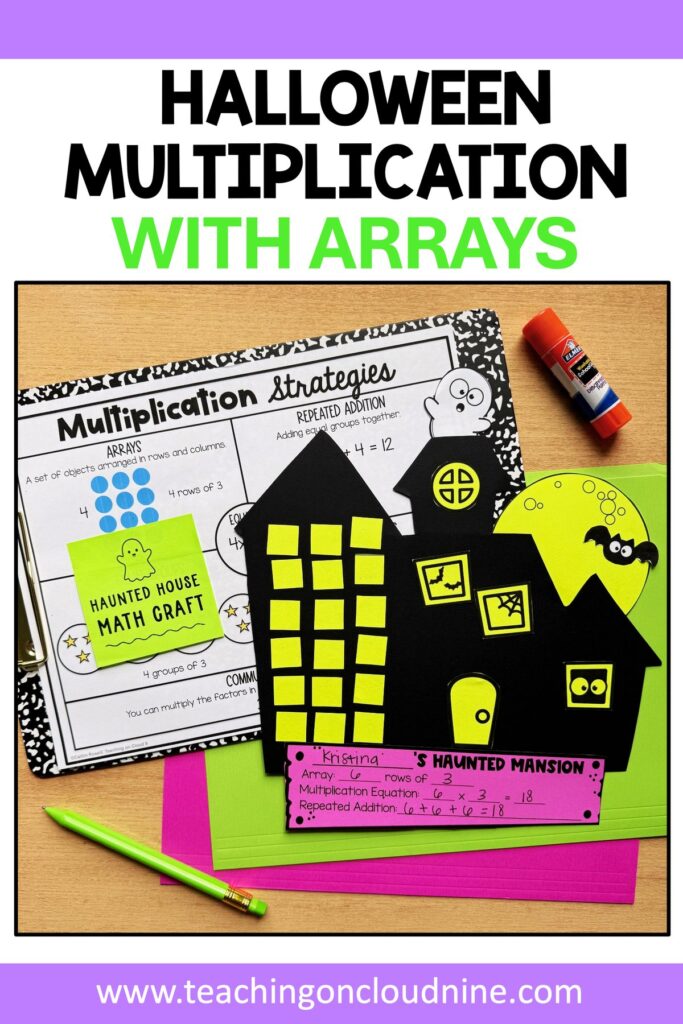
Are you looking for math array examples that will actually get your 3rd grade students excited about multiplication? These two Halloween math crafts turn array models into something kids want to build. Students create a spooky haunted house or a cozy pumpkin house, and every window becomes part of an array. By the end, they can show the same multiplication problems three different ways.
What Is an Array in Math?
An array is a set of objects arranged in equal rows and columns. It’s one of the best visual representations of multiplication because students can actually see the equal groups.
When I introduce arrays, I always start with everyday objects. Egg cartons, muffin tins, and rows of desks are all real world math array examples kids already know. I ask, “How many rows? How many in each row? What’s the total number of objects?”
Arrays build a strong understanding of multiplication in a few ways:
- Equal rows: The number of rows is the first factor and the number of columns is the second factor.
- Repeated addition: A 4 rows of 3 array can be written as the repeated addition equation 3 + 3 + 3 + 3 = 12.
- Multiplication equation: That same array becomes the multiplication sentence 4 x 3 = 12.
- Commutative property of multiplication: Turn the array on its side and you get 3 rows of 4. The order of the factors changes, but the product stays the same.
Arrays also set students up for area models and larger numbers later on. Once kids can picture a rectangular array, multiplication facts make so much more sense.
Before we ever pick up glue sticks, I hang a Multiplication Strategies anchor chart in our room. It shows arrays, repeated addition, equal groups, skip counting, and the commutative property side by side. Students use it as a visual aid while they work, and I can point back to it during small groups. You’ll see it behind both crafts in the pictures below. Having one chart with all of the strategies helps kids see that each one is just a different way to solve the same math problem.
Haunted House Array City Math Craft
The Haunted House Array City craft is a spooky fun way to practice multiplication with arrays and repeated addition. Students build their own haunted mansion and use bright yellow array squares as the windows.
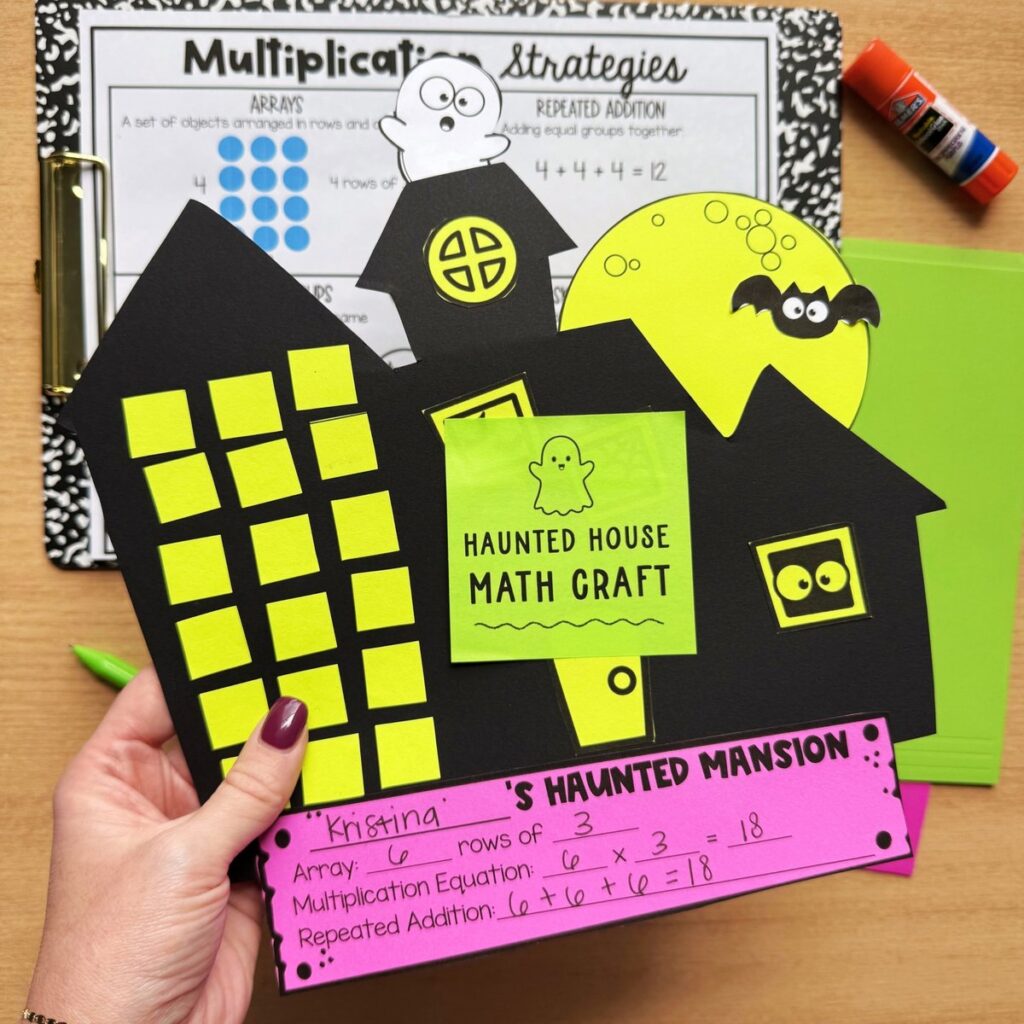
Here’s how it works:
- Students pick one of the 6 haunted mansion templates.
- They glue on array squares in equal rows to make their windows.
- They add haunted mansion decorations like bats, ghosts, a moon, and spooky windows.
- They fill in the math sheet and glue it to the bottom of their mansion.
The math sheet asks students to write their array (like 6 rows of 3), the multiplication equation (6 x 3 = 18), and the repeated addition (6 + 6 + 6 = 18). It’s a great way to check if students really understand the concept of multiplication and not just their times tables.
What’s included:
- 6 Haunted Mansion templates
- Array squares
- Haunted Mansion decorations
- Math sheet to glue on the Haunted Mansion
- 2 practice sheets
- Easy cut square bulletin board letters: “Haunted Multiplication Mansions”
Pumpkin Arrays City Math Craft
If you’d rather keep things more fall than spooky, the Pumpkin Arrays City craft is perfect. Students build their own pumpkin house while practicing multiplication and repeated addition with arrays.
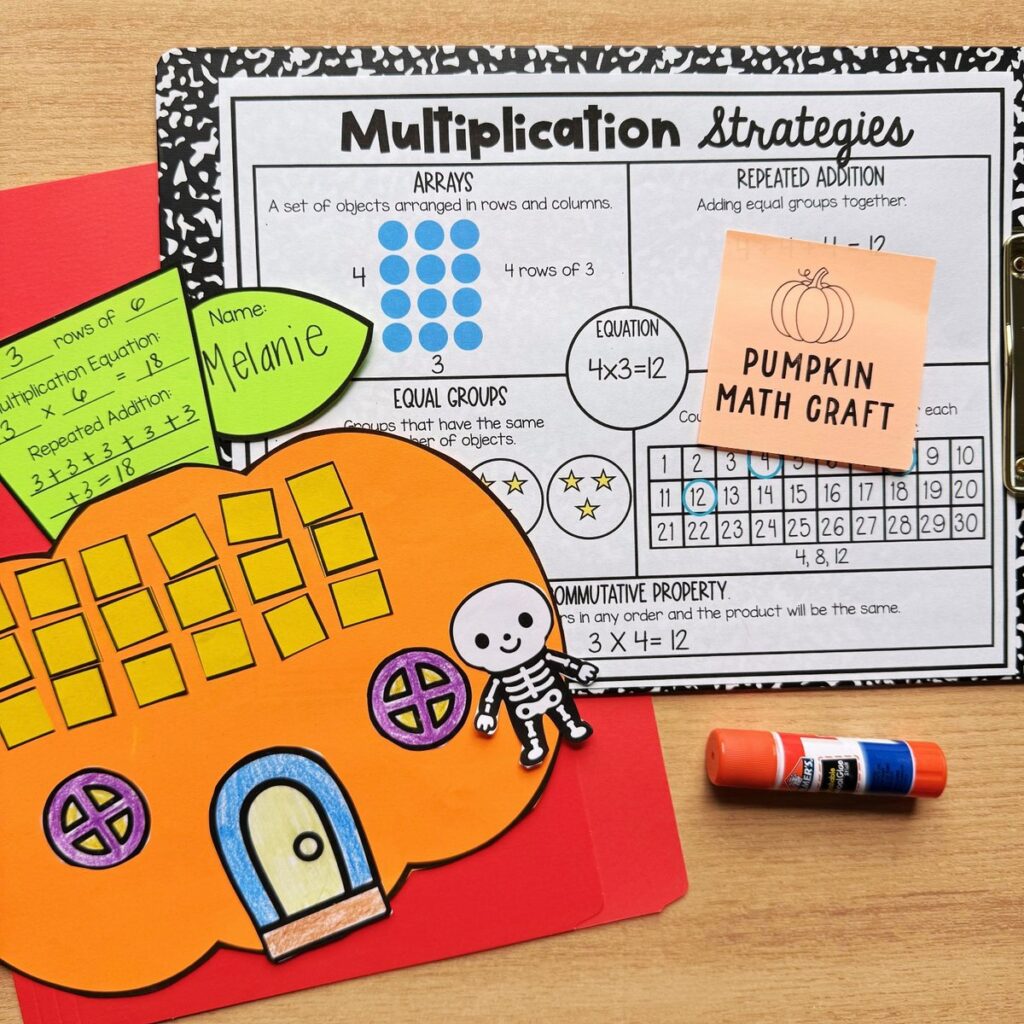
Students choose a pumpkin template and glue yellow window squares in equal rows to make their array. Then they decorate with doors, windows, and Halloween friends like a friendly skeleton. The pumpkin stem is where they show their thinking. They write the array, the multiplication equation, and the repeated addition.
In the example above, the student made 3 rows of 6. Her multiplication equation is 3 x 6 = 18, and her repeated addition is 3 + 3 + 3 + 3 + 3 + 3 = 18. Compare that to the haunted house, which shows 6 rows of 3. It’s the same product with different arrays, which is the perfect lead-in to the commutative property! Arrays are also a great bridge to division and fact families.
What’s included:
- 5 pumpkin templates
- Array squares (yellow windows)
- Choices for doors, windows, and Halloween friends to add
- Stem to write the multiplication equation and repeated addition
- Optional practice worksheets
- Easy cut square bulletin board letters: “Hip, Hip, Array for Halloween!” and “Pumpkin Village Arrays”
The finished pumpkins make the cutest bulletin board display for fall or Halloween.
Tips for Teaching With These Math Array Examples
Here are a few things that help these crafts run smoothly in my classroom:
- Start with the practice pages. Both crafts include practice pages. I have students complete them first so they understand arrays, the multiplication equation, and repeated addition before they build. Then they know exactly how the craft will work when it’s time to cut and glue.
- Model one first. Build an array together on the board before students start gluing. Show them how to line up the squares in straight horizontal lines and vertical lines.
- Assign different arrays. Give each student a different number of rows and columns. When you hang them up, your bulletin board becomes a wall of different arrays and multiplication facts.
- Use concrete materials first. Let students build the array with counters or cubes before they glue. It helps young learners connect the hands-on model to the picture.
- Add word problems. Once the crafts are done, write a word problem for each one. “The haunted mansion has 6 rows of 3 windows. How many windows in all?”
These crafts also work well as a review for 2nd grade students who are just starting with equal groups, or as a fun Halloween math center.
Get an Entire Year of Math Crafts
If your students love the haunted house, you’ll love the Third Grade Math Craft Bundle. It includes an entire year of 3rd grade math crafts, including the Haunted House Array City, a turkey multiplication craft, a snowman area craft, a penguin snow globe for addition and subtraction, a Christmas tree fact family craft, and more. (The Pumpkin Arrays City craft is sold separately.)
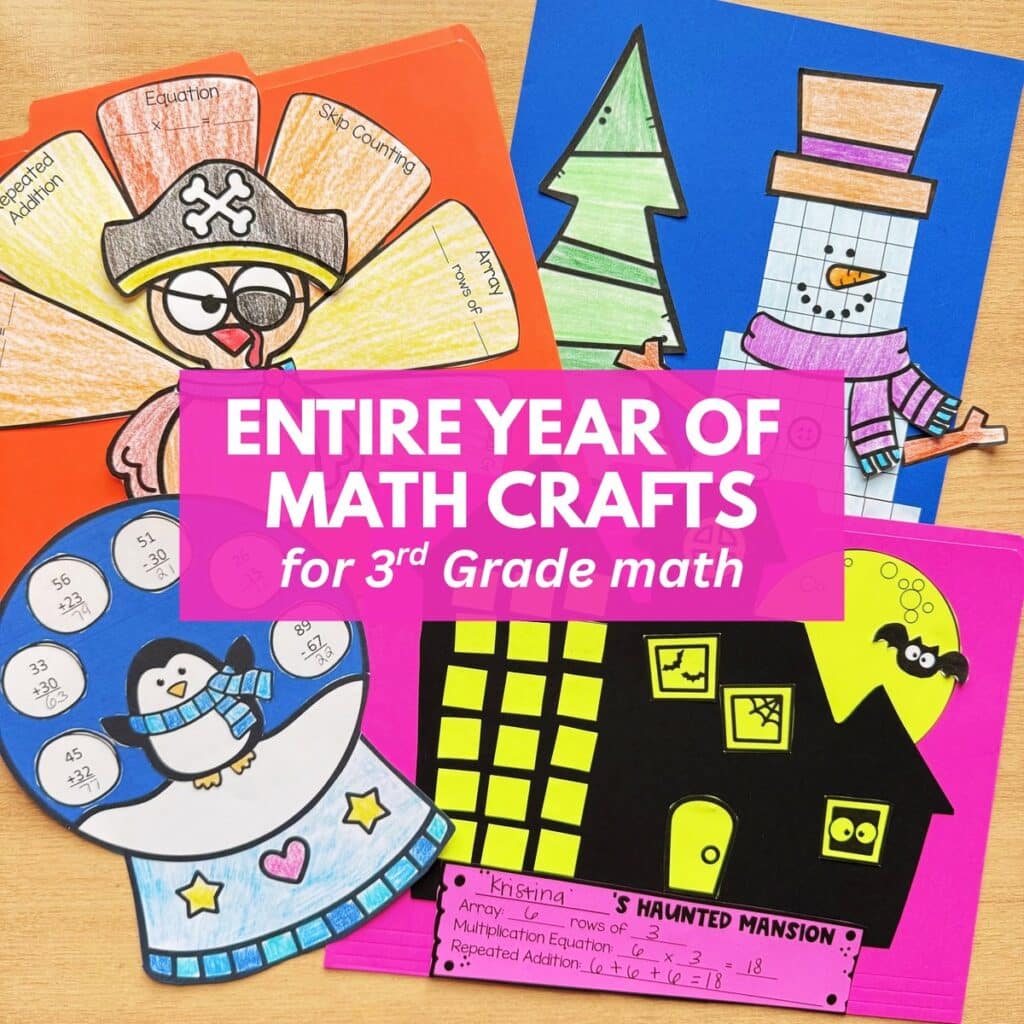
It’s a great way to keep math hands-on and seasonal all year long without having to plan something new every month.
I hope these math array examples help you bring a little Halloween fun into your multiplication unit! Your students will be so proud to see their haunted houses and pumpkins on display.
Happy haunting, friends!